Dashboard
Dashboard
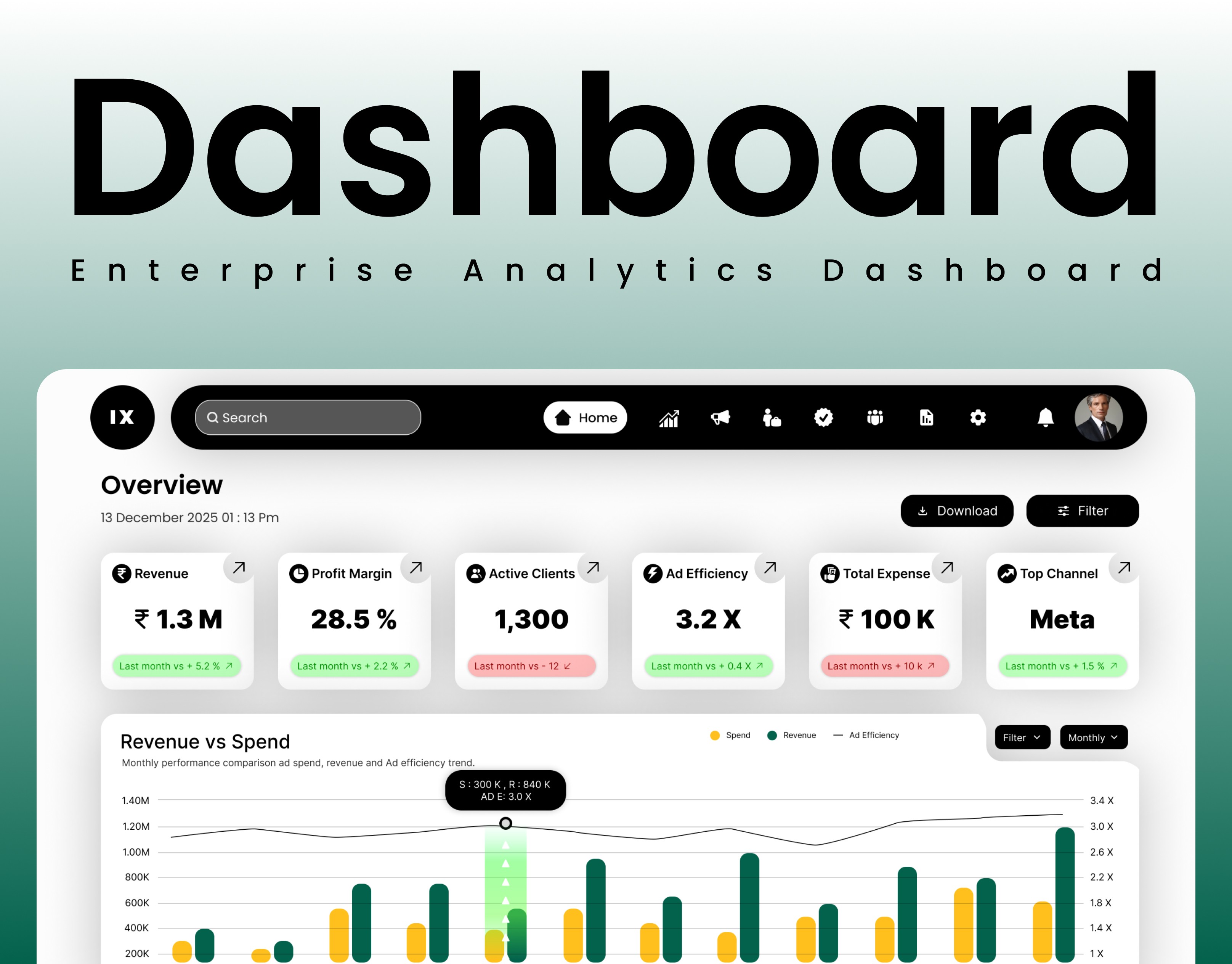
A flexible design system was created to support complex data visualization needs across the platform. Modular components such as cards, graphs, tables, and filters ensure consistency and scalability. The system allows easy customization for different departments while maintaining a unified experience across the enterprise ecosystem.
Stakeholder-Centric Research
Stakeholder-Centric Research
The research focused on understanding the needs of high-level stakeholders including CEOs, managers, and department heads. By analyzing decision-making patterns across marketing, finance, and operations, key insights were gathered on how users consume data. The goal was to design a system that transforms complex data into clear, actionable insights for faster executive decisions.
The research focused on understanding the needs of high-level stakeholders including CEOs, managers, and department heads. By analyzing decision-making patterns across marketing, finance, and operations, key insights were gathered on how users consume data. The goal was to design a system that transforms complex data into clear, actionable insights for faster executive decisions.
Stakeholder-Centric Research
The research focused on understanding the needs of high-level stakeholders including CEOs, managers, and department heads. By analyzing decision-making patterns across marketing, finance, and operations, key insights were gathered on how users consume data. The goal was to design a system that transforms complex data into clear, actionable insights for faster executive decisions.
Information Architecture & Data Hierarchy
Information Architecture & Data Hierarchy
A robust information architecture was designed to handle large-scale enterprise data efficiently. The dashboard prioritizes critical metrics through clear data hierarchy, ensuring that high-impact insights are immediately visible. Logical grouping of marketing, financial, productivity, and client data allows users to seamlessly navigate between different business perspectives without cognitive overload.
A robust information architecture was designed to handle large-scale enterprise data efficiently. The dashboard prioritizes critical metrics through clear data hierarchy, ensuring that high-impact insights are immediately visible. Logical grouping of marketing, financial, productivity, and client data allows users to seamlessly navigate between different business perspectives without cognitive overload.
Information Architecture & Data Hierarchy
A robust information architecture was designed to handle large-scale enterprise data efficiently. The dashboard prioritizes critical metrics through clear data hierarchy, ensuring that high-impact insights are immediately visible. Logical grouping of marketing, financial, productivity, and client data allows users to seamlessly navigate between different business perspectives without cognitive overload.
Insight-Driven UX Strategy
Insight-Driven UX Strategy
The UX strategy focused on delivering insights rather than just data. Visual storytelling techniques like charts, comparisons, and trend indicators were used to highlight performance and anomalies. The design enables users to quickly identify patterns, track KPIs, and make strategic decisions, reducing the time spent interpreting raw data.
The UX strategy focused on delivering insights rather than just data. Visual storytelling techniques like charts, comparisons, and trend indicators were used to highlight performance and anomalies. The design enables users to quickly identify patterns, track KPIs, and make strategic decisions, reducing the time spent interpreting raw data.
Insight-Driven UX Strategy
The UX strategy focused on delivering insights rather than just data. Visual storytelling techniques like charts, comparisons, and trend indicators were used to highlight performance and anomalies. The design enables users to quickly identify patterns, track KPIs, and make strategic decisions, reducing the time spent interpreting raw data.

Usability & Decision Efficiency Testing
Usability & Decision Efficiency Testing
Testing focused on how efficiently users could interpret data and make decisions. Real-world scenarios were used to evaluate clarity, accessibility, and interaction flows. Iterative improvements ensured that users can quickly access relevant insights, reduce errors, and confidently make business-critical decisions using the dashboard.
Testing focused on how efficiently users could interpret data and make decisions. Real-world scenarios were used to evaluate clarity, accessibility, and interaction flows. Iterative improvements ensured that users can quickly access relevant insights, reduce errors, and confidently make business-critical decisions using the dashboard.
Usability & Decision Efficiency Testing
Testing focused on how efficiently users could interpret data and make decisions. Real-world scenarios were used to evaluate clarity, accessibility, and interaction flows. Iterative improvements ensured that users can quickly access relevant insights, reduce errors, and confidently make business-critical decisions using the dashboard.


More Works More Works
More Works More Works

©2026baskarthedesigner
Go Back To Top
©2026baskarthedesigner
Go Back To Top